Following the reign of the Flavians - Vespasian, Titus and Domitian - came the short but liberalizing rule of Nerva (96-98 CE). One of the first reforms he instituted concerned the department (Fiscus Judaicus) responsible for the collection of the Jewish head tax. One theory espoused that this coin commemorated the abolishment of the tax. Later, it was postulated that this coin commemorated the end of the insulting methods of collecting the tax, which had demanded visible (and public) proof of circumcision. However, in her paper “The Interpretation and Wider Context of Nerva’s Fiscus Judaicus Sestertius, presented at the International Conference Judaea and Rome in Coins,hosted by Spink in 2010, Marius Heemstra came to the conclusion that “Nerva’s coin … is very plausibly evidence that the new emperor no longer permitted people to be accused of living a Jewish life. This specific accusation became a ‘wrongful accusation’ (calumnia). Towards the end of [his predecessor] Domitian’s reign, high-ranking Romans accused of ‘living a Jewish life’ could have their property confiscated and they could even end up being executed.
A large bronze sestertius was issued to commemorate this reform. This scarce coin features a palm tree, that had become symbolic of the Jewish people on the Judaea Capta coins, and the Latin inscriptions "FISCI IVDAICI CALVMNIA SVBLATA" (the calumny of the Jewish tax is removed) and "S C" (by consent of the Senate). (#93)
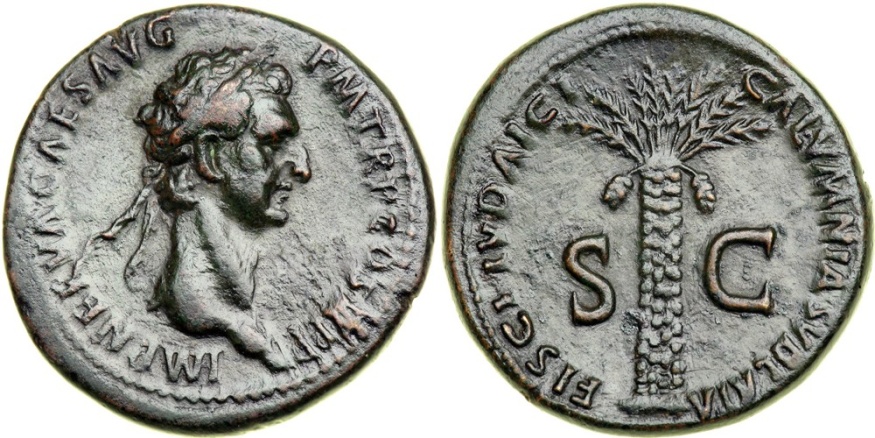
#93 Nerva sestertius, 96 CE ( H-1603)
 |
 |
 |
 |
 |
© 2020-Mel Wacks