The
Roman Emperor Heraclius lost Jerusalem to the Arabian Khalif Omar in 637
CE, after a few month's siege. One of the first coins struck in Palestine
by the Arabs (c. 650 CE) is an imitation of a Byzantine coin, picturing
Heraclius in the center, flanked by his sons Heraclius Constantine and Heraclonas,
each holding a small globe with a cross; on the reverse is a large "M" (the
denomination), along with the name of the city in Latin and Arabic. (#125)
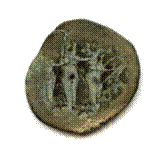
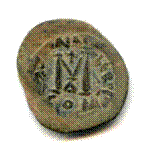
#125
Tiberias Copper Fals c. 650 CE
The Umayyad Governors also struck several varieties of small bronze coins (fals denomination) in imitation of earlier Jewish coins. These feature an amphora (like the First Revolt bronze prutah) (#126), 5-branched candelabrum (like the Menorah coin of Antigonus Mattathias) (#127), and pomegranate (like the pomegranate buds on the famous First Revolt shekels) (#128). The Arabic inscriptions read "There is No God but Allah Alone" and "Muhammad is the Apostle of Allah."
The Umayyad Governors also struck several varieties of small bronze coins (fals denomination) in imitation of earlier Jewish coins. These feature an amphora (like the First Revolt bronze prutah) (#126), 5-branched candelabrum (like the Menorah coin of Antigonus Mattathias) (#127), and pomegranate (like the pomegranate buds on the famous First Revolt shekels) (#128). The Arabic inscriptions read "There is No God but Allah Alone" and "Muhammad is the Apostle of Allah."
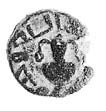
#126 Anonymous Copper Fals (Islamic Coins, Berman, 1976, No. 66)

#127 Anonymous Copper Fals (Islamic Coins, Berman, 1976, No. 68)
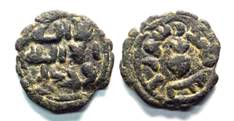
#128 Anonymous Copper Fals (Islamic Coins, Berman, 1976, No. 70)
The Caliph himself was portrayed on coins struck in Jerusalem c. 670-685 CE. He stands facing, wearing a long robe and native head-dress; his right hand is placed on a sword. The name of the mint in Arabic "Iliya Filistin" is indicated on the reverse. (#129)
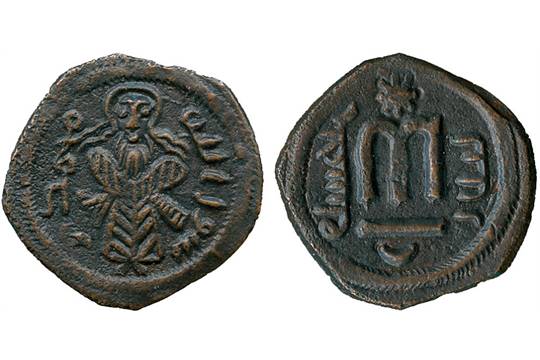
#129 “Muhammad Rasul Allah” Copper Fals c. 670-685 CE
Around the turn of the first millennium, the Arabs began striking gold dinars in Palestine. Such a coin was struck at the Filistin mint by Abu'l-Qasim (948-949 CE). The legends read in part: "There is No God but Allah Alone, He Has No Associate" and "Allah, Muhammad Is the Apostle of Allah, God Bless Him." (#130)
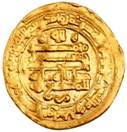
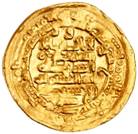
#130 Abu'l-Qasim , Gold Dinar, Filistin, 948-949 CE
 |
 |
 |
 |
 |
© 2020-Mel Wacks