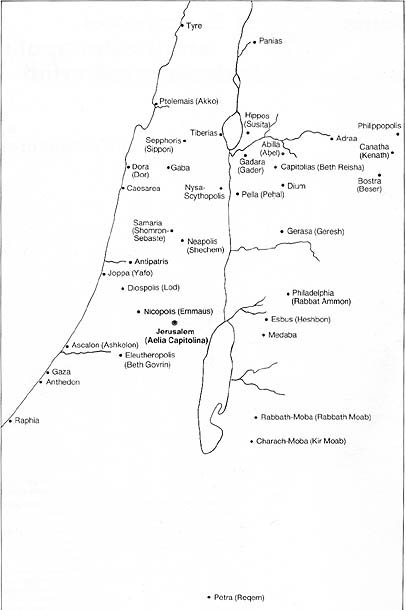
Coastal Cities: Ptolemais (Akko), Dora (Dor), Caesarea, Joppa (Yafo), Ascalon (Ashkelon), Gaza, Anthedon, Raphia
Inland Cities: Tiberias, Sepphoris (Sippori), Gaba, Nysa-Scythopolis, Samaria (Shomron-Sebaste), Neapolis (Shechem), Antipatris, Diospolis (Lod), Nicopolis (Emmaus), Aelia Capitolina (Jerusalem), Eleutheropolis (Beth Govrin)
Cities of Transjordan: Panias, Philippopolis, Hippos (Susita), Canatha (Kenath), Abilla (Abel), Gadara (Gader), Adraa, Capitolias (Beth Reisha), Bostra (Beser), Dium, Pella (Pehal), Gerasa (Geresh), Philadelphia (Rabbat Ammon), Esbus (Heshbon), Medeba, Rabbath-Moba (Rabbath Moab), Charach-Moba (Kir Moab), Petra (Reqem)
While a scattering of city coins were minted earlier, the time of the First Revolt (66-70 CE) saw the initial pronounced production of city coins in Judaea ... and the number of mints blossomed after the defeat of the Jews in the Second Revolt (132-135 CE). The Ascalon Mint deserves special mention, since it produced coins almost continuously from about 375 BCE through 235 CE; one of its more interesting issues features the famous Cleopatra on a silver shekel. (#118)
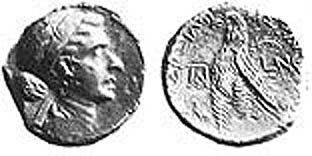
#118 Shekel from Ascalon featuring Cleopatra VII, 47 BCE
A few cities, with large Jewish populations - Neapolis (#119) and Sepphoris (#120) -- initially struck coins with Jewish symbols.
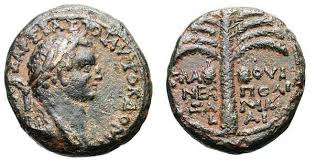
#119 Neapolis, Domitian 82/83 CE
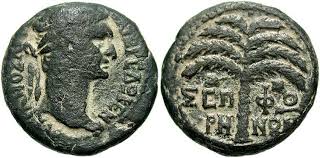
#120 Sepphoris, Trajan 98-117 CE
A previously unknown coin (#121), offered by fontanillecoins.com, depicts the tower and walls (tell) of the city of Akko-Ptolemais.
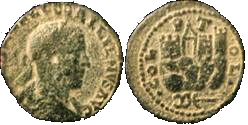
#121 Akko-Ptolemais, Galienus 253-268 CE
Some historic coins -- issued by Aelia Capitolina/Jerusalem (#122), Caesarea (#123), etc. -- picture the Roman ceremonial founding of the city. The Emperor is shown in a cart pulled by a bull and ox, defining the boundary as the area enclosed by a plough in 24 hours.
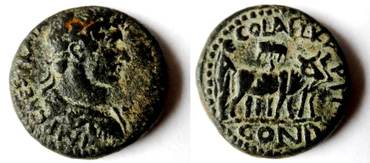
#122 Aelia Capitolina, Hadrian 130 CE (H-Fig. 10.1 )
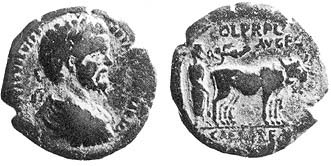
#123 Caesarea, Septimus Severus 193-211 CE
But the coins of these cities eventually joined with the others in depicting Roman gods, goddesses, temples, etc. One of the most interesting designs depicts a Roman temple, dedicated to the worship of Jupiter "The Supreme God," which was erected on the former site of the Samaritan Temple atop Mt. Gerizim. (#124)
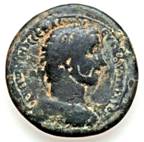
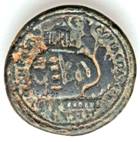
124 Neapolis, Antoninus Pius 160 CE
This extensive series of Palestine city-coins finally came to an end during the reign of Gallienus (253-268 CE), when the Roman Empire disintegrated.
 |
 |
 |
 |
 |
© 2020-Mel Wacks